
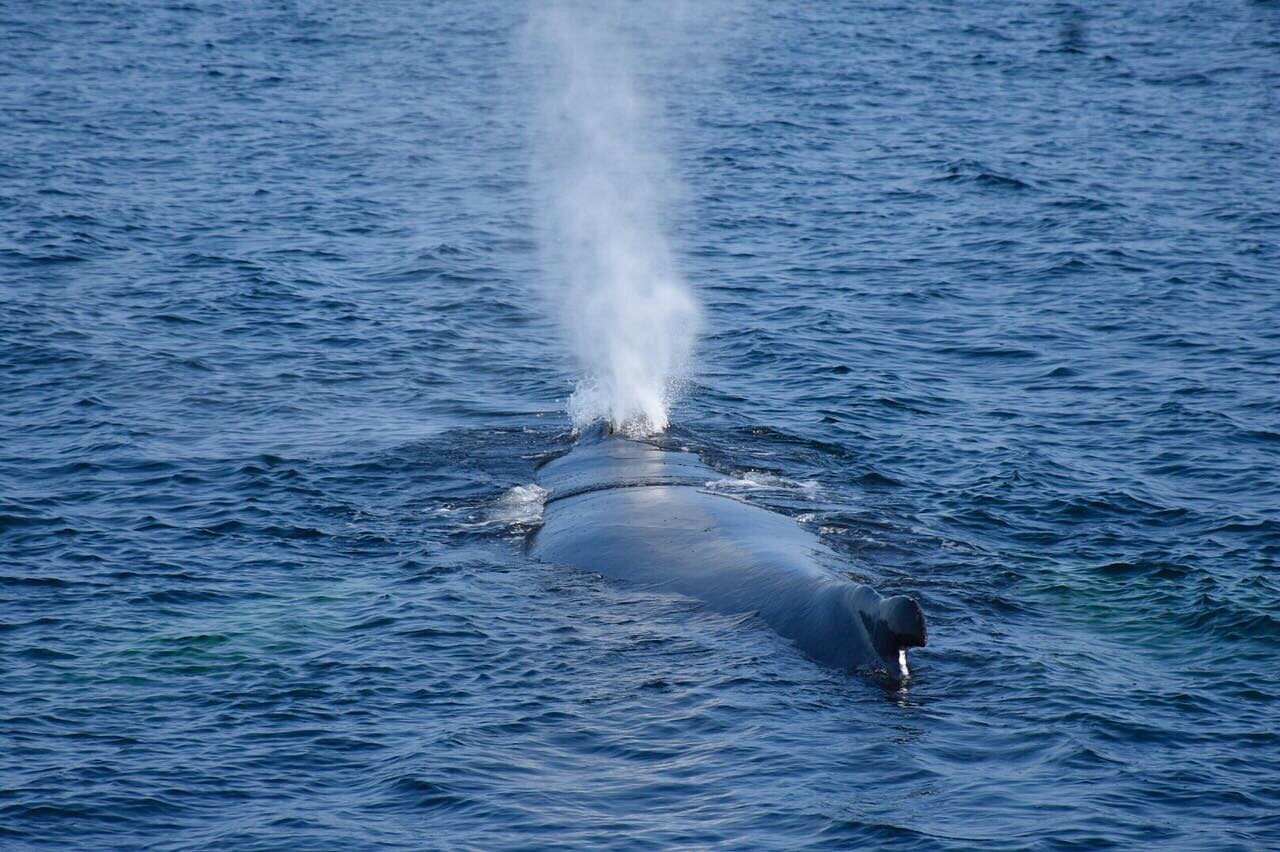
Stellwagen Bank — 28 miles east of Gloucester — is a 638-square-mile federal marine sanctuary, ranked by the World Wildlife Fund as one of the Top 5 whale watching destinations on the planet. Here's who shows up to feed.
Humpback Whale
Megaptera novaeangliae · Length: 48–52 ft · Most Common
The showstopper. Humpbacks return to Stellwagen Bank every spring to gorge themselves on sand lance, herring and krill. They breach (launch their 40-ton bodies clean out of the water), lobtail (slam their flukes on the surface), and lunge-feed cooperatively with their mouths agape and seagulls diving for scraps. Each humpback's tail is uniquely marked — our naturalists know most of the regulars by name.
Humpback tails are so strong that it takes only two or three kicks to hurl an entire 40-ton body out of the water. We see this almost every trip.
Fin Whale
Balaenoptera physalus · Length: 65–75 ft · Regular Sightings
The second-largest animal that has ever lived on Earth — only the blue whale is bigger. Fin whales are sleek, fast, and asymmetric: their right lower jaw is white, the left dark. They cruise at 25 knots when motivated. Their tall, narrow blow is visible from miles away, often the first sign of a whale on the horizon.
Minke Whale
Balaenoptera acutorostrata · Length: 23–30 ft · Common
The smallest baleen whale on the bank — quick, curious, and often solo. Minkes have distinctive white bands on their flippers. They surface with a sharp pointed nose and a quiet, smaller blow than the bigger species. Often the first whale spotted on a trip.
Atlantic White-Sided Dolphin
Lagenorhynchus acutus · Pod Size: 50–500 · Common
Pods of 50 to several hundred — sometimes a thousand — bow-riding, leaping in formation, scattering across the surface. Some trips, we have hundreds of dolphins around the boat at once. It's pure joy on the water.
North Atlantic Right Whale
Eubalaena glacialis · Population: ~360 remain · Rare · Spring
One of the rarest large mammals on Earth — fewer than 360 right whales remain in existence. Stellwagen is critical habitat. When we encounter right whales, we follow strict federal viewing rules (minimum 500 yards) to protect them. Spotting one is a privilege — and increasingly rare.
And Sometimes...
Blue Whale
The largest animal that has ever lived. Once or twice a season, a blue whale passes through Stellwagen. Adults reach 90+ feet and 200 tons. If you happen to be on the trip when one surfaces, it's a memory you carry forever.
Sperm Whale
Deep-diving toothed whales, the species of Moby Dick. Males can reach 60 feet. They surface occasionally on offshore trips when our captains push out to deeper water.
Pilot Whale & Sei Whale
Pilot whales travel in tight family pods. Sei whales are sleek and seasonal — fast surface feeders that come and go quickly.
Plus: Harbor Porpoises, Harbor Seals, Sea Turtles, Sunfish, Pelagic Birds
Every trip is different. We've had leatherback sea turtles, basking sharks, ocean sunfish (mola mola), and storm petrels follow the boat. The ocean delivers surprises.